
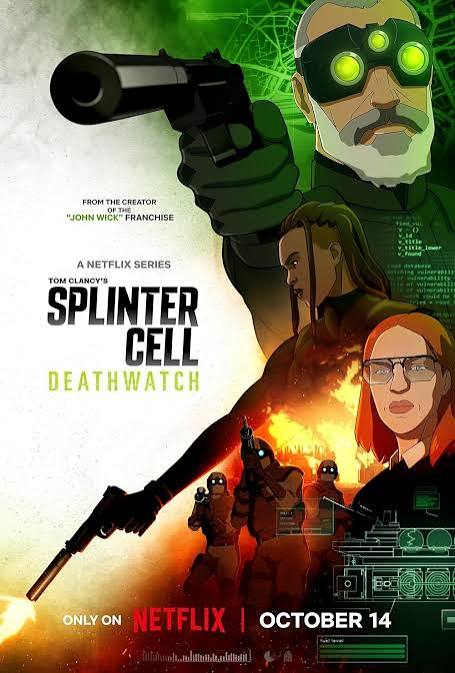

When a beloved video game franchise makes the jump to animated series, anticipation and skepticism both skyrocket. Netflix’s Splinter Cell Deathwatch is that leap reimagining Tom Clancy’s stealth-action saga for a mature, animated format. But does it satisfy longtime fans while inviting new viewers in? Let’s delve deep.
What Is Splinter Cell Deathwatch?
Splinter Cell Deathwatch is an adult animated espionage-thriller series created by Derek Kolstad (known for John Wick) and produced by Ubisoft Film & Television, with animation by Sun Creature and Fost Studios.
It premiered globally on October 14, 2025, exclusively on Netflix.
There are 8 episodes in Season 1, each running ~20–27 minutes.
Kolstad has stated that the show is not a reboot, but rather a continuation (or “legacyquel”) of the Splinter Cell universe, preserving canonical lore while exploring new angles.
Story & Premise
In Deathwatch, Sam Fisher, now older, living in retirement is pulled back into the shadows when a wounded young operative named Zinnia McKenna seeks his help. Their mission unravels a global conspiracy tied to Fisher’s past.
The series weaves together themes of legacy, trust, shadows versus light, and the price of secrets. It also nods to the past particularly the Chaos Theory era with ties to familiar factions like Displace.
Unlike the methodical stealth pacing of the games, the show balances stealth and high-octane action gunfights, infiltration, and sudden confrontations.
Characters & Voice Cast
- Sam Fisher is voiced by Liev Schreiber, who replaces longtime series voice Michael Ironside. The recast is intentional: Kolstad opted for a “new sound” as the series may continue for multiple seasons.
- Zinnia McKenna (voiced by Kirby Howell-Baptiste) is the young operative who brings Fisher back into the field.
- Anna “Grim” Grímsdóttir returns as Fisher’s longtime technical support.
- Other supporting cast include Joel Oulette (Thunder) and voices from Helen Hong, Navid Negahban, Kari Wahlgren, Bella Dayne, etc.
The dynamic is built on Fisher’s world-weariness vs Zinnia’s urgency, coupled with lingering emotional trauma from his past operations.
Animation & Visuals
One of the big challenges in adapting Splinter Cell is replicating its signature interplay of light and shadow. The series attempts this via a stylized 2D/3D hybrid look moody, dark, often with sharp contrasts.
That said, some critics feel the animation doesn’t always rise to the game’s visual legacy. It occasionally leans toward a more generic, less fluid style, especially in movements and action transitions.
Nevertheless, there are standout sequences (particularly near the finale) that push closer to what fans might expect from a stealth-action adaptation.
Easter Eggs & Game Callbacks
For longtime fans, Deathwatch sprinkles in many Easter eggs and references:
- The private military company Displace International, tied historically to antagonist Douglas Shetland.
- Fisher’s aliases from novels and games (e.g. Kaufmann, Carpenter) appear in dialogue. Netflix
- Subtle graphical references in UI, credentials, and screens described in Ubisoft’s Easter egg article.
- The Chaos Theory arc is referenced in the show’s story paths.
These nods enrich the experience for game veterans without making the show inaccessible to newcomers.
What Works / What Doesn’t
Strengths
- Strong Lead Performance: Schreiber’s gravitas carries many weaker segments.
- Tight Storytelling: At eight episodes, the pacing feels lean and focused rather than overextended.
- Lore Respect & Expansion: It honors the game canon while expanding on Fisher’s emotional side.
- Visual Ambition: Several standout sequences remind you this is a stealth action show in animated form.
Weaknesses
- Inconsistent Animation Quality: Some movements feel wooden or generic, not always matching the ambition.
- Villain Depth: Some critics say antagonists are underdeveloped and lack compelling presence.
- Shifts Toward Action Over Stealth: For a Splinter Cell title, the balance sometimes leans more into firefights and less into classic infiltration.
- High Expectations Pressure: Many fans expected something on par with Arcane, Castlevania, or Ghost in the Shell standards that are tough to meet.
Season 2 & Legacy Potential
Netflix has already renewed Splinter Cell Deathwatch for a second season.
That signals confidence in its concept and performance, despite mixed critical reactions.
If handled well, future seasons can deepen the characters, sharpen the villainy, and lean harder into stealth mechanics rather than pure action. There’s real potential for Deathwatch to become a defining animated espionage franchise.
Verdict & Recommendation
Splinter Cell Deathwatch is a bold, imperfect adaptation. It doesn’t always hit every note fans might hope for, but its strengths solid performances, faithful lore adaptation, and ambitious scope make it worth your watch. If you’re a fan of espionage, animated thrillers, or just curious to see video games reimagined for TV, this one’s a worthwhile mission.
Also Read : Netflix October 2025 Releases (USA): Full List of New Movies & Shows Coming This Month